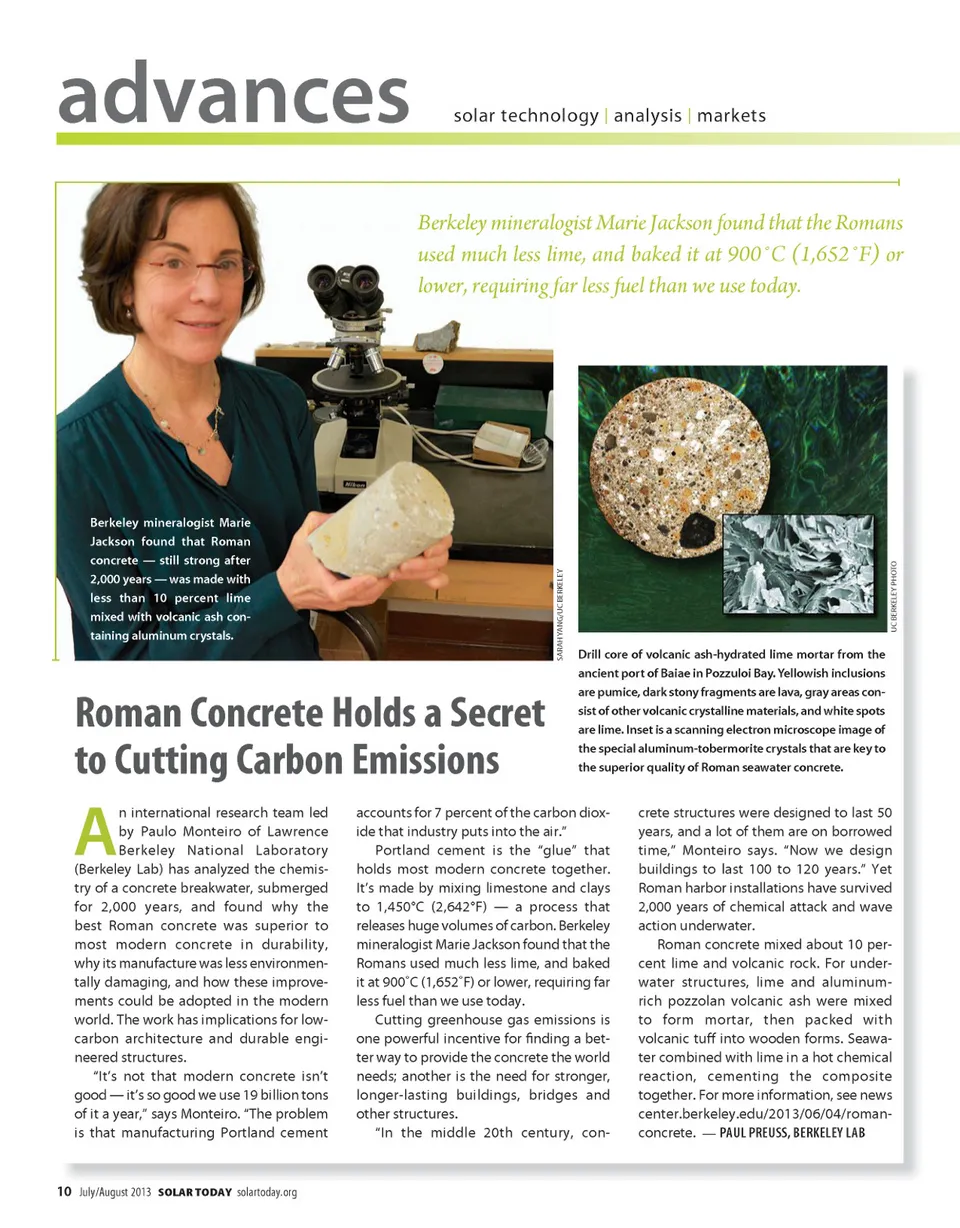
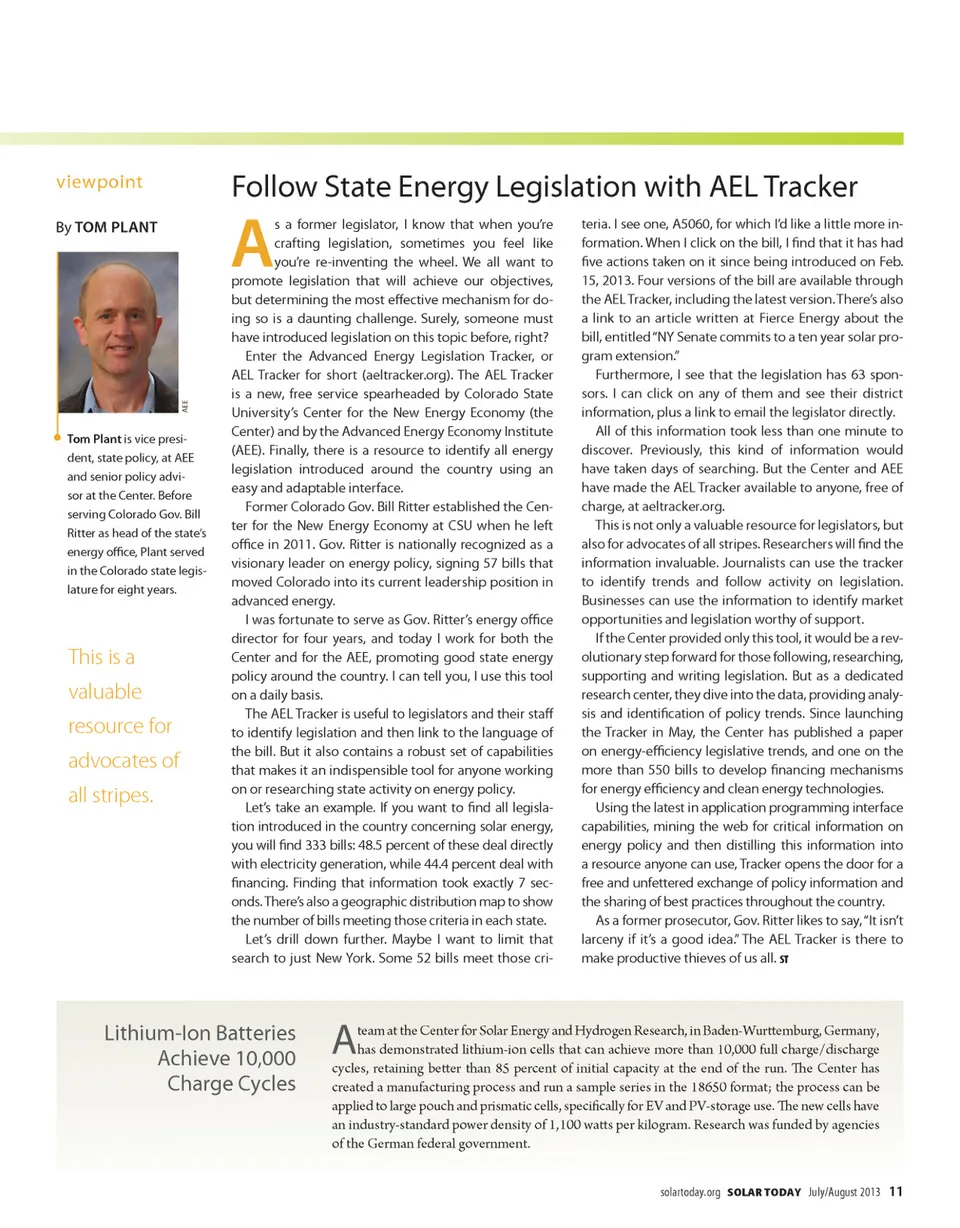
advances solar technology | analysis | markets Berkeley mineralogist Marie Jackson found that the Romans used much less lime, and baked it at 900˚C (1,652˚F) or lower, requiring far less fuel than we use today. S ARAH YANG / UC BERKELEY Berkeley mineralogist Marie Jackson found that Roman concrete — still strong after 2,000 years — was made with less than 10 percent lime mixed with volcanic ash con-taining aluminum crystals. Roman Concrete Holds a Secret to Cutting Carbon Emissions Drill core of volcanic ash-hydrated lime mortar from the ancient port of Baiae in Pozzuloi Bay. Yellowish inclusions are pumice, dark stony fragments are lava, gray areas con-sist of other volcanic crystalline materials, and white spots are lime. Inset is a scanning electron microscope image of the special aluminum-tobermorite crystals that are key to the superior quality of Roman seawater concrete. A n inte r n a ti o n a l r ese ar ch te a m le d b y Pa ul o Mo ntei ro of L a w r ence Be r kele y N a ti o n a l L a b ora t ory (Be r kele y L a b) h a s a n a l y ze d the chemis -t ry of a c o nc r ete b r e a kw a te r , subme r ge d for 2 , 000 y e ar s, a n d fo un d wh y the best R o m a n c o nc r ete w a s su p e r i or t o m o st m od e r n c o nc r ete in d u ra bilit y , wh y its m a nu fa ctu r e w a s less envi ro nmen -t a ll y da m a ging, a n d h o w these im pro ve -ments c o ul d be adop te d in the m od e r n w or l d. The w or k h a s im p lic a ti o ns for l o w -c ar b o n ar chitectu r e a n d d u ra ble engi -nee r e d st r uctu r es . “It’s n o t th a t m od e r n c o nc r ete isn’t g ood — it’s s o g ood we use 1 9 billi o n t o ns of it a y e ar ,” s ay s Mo ntei ro. “The pro blem is th a t m a nu fa ctu r ing Por tl a n d cement a cc o unts for 7 p e r cent of the c ar b o n d i o x -i d e th a t in d ust ry p uts int o the a i r. ” Por tl a n d cement is the “glue” th a t h o l d s m o st m od e r n c o nc r ete t o gethe r. It’s m ad e b y mixing limest o ne a n d cl ay s t o 1, 4 5 0 °C ( 2 , 642 °F) — a pro cess th a t r ele a ses huge v o lumes of c ar b o n . Be r kele y mine ra l o gist Mar ie J a cks o n fo un d th a t the R o m a ns use d much less lime, a n d b a ke d it a t 900 ˚C (1, 6 5 2 ˚F) or l o we r , r equi r ing far less f uel th a n we use t oday. Cutting g r eenh o use g a s emissi o ns is o ne po we rf ul incentive for fin d ing a bet -te r w ay t o pro vi d e the c o nc r ete the w or l d nee d s; a n o the r is the nee d for st ro nge r , l o nge r-l a sting buil d ings, b r i d ges a n d o the r st r uctu r es . “In the mi dd le 20 th centu ry , c o n -c r ete st r uctu r es we r e d esigne d t o l a st 5 0 y e ar s, a n d a l o t of them ar e o n b orro we d time,” Mo ntei ro s ay s . “N o w we d esign buil d ings t o l a st 1 00 t o 1 20 y e ar s . ” Yet R o m a n h ar b or inst a ll a ti o ns h a ve su r vive d 2 , 000 y e ar s of chemic a l a tt a ck a n d w a ve a cti o n un d e r w a te r. R o m a n c o nc r ete mixe d a b o ut 1 0 p e r-cent lime a n d v o lc a nic ro ck . F or un d e r-w a te r st r uctu r es, lime a n d a luminum -r ich po zz o l a n v o lc a nic a sh we r e mixe d t o for m m or t ar , then pa cke d with v o lc a nic tuff int o w ood en for ms . S e a w a-te r c o mbine d with lime in a h o t chemic a l r e a cti o n, cementing the c o m po site t o gethe r. F or m or e in for m a ti o n, see news cente r. be r kele y. e d u /20 1 3/06/04/ro m a n -c o nc r ete . — PAUL PREUSS, BERKELEY LAB 10 July/August 2013 SOLAR TODAY solartoday.org Copyright © 2013 by the American Solar Energy Society Inc. All rights reserved. UC BERKELEY P HOTO
Solar Today July/August 2013: Page 10